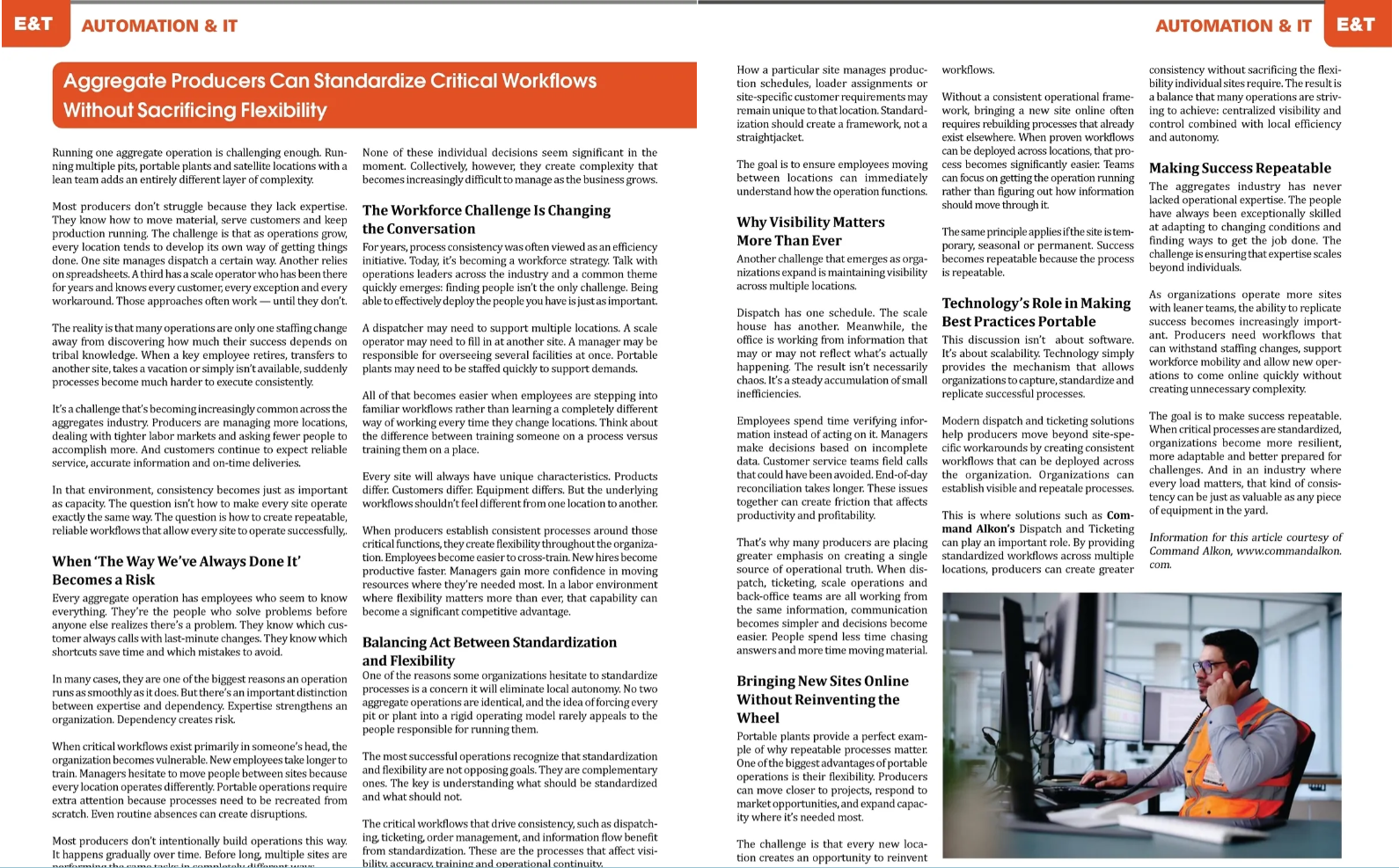

You can read the published article in Rock Product’s July 2026 issue here.
The Real Challenge of Running Multiple Sites Isn’t Production – It’s Consistency
How Aggregate Producers Can Standardize Critical Workflows Without Sacrificing Flexibility
Running one aggregate operation is challenging enough. Running multiple pits, portable plants, and satellite locations with a lean team adds an entirely different layer of complexity.
Most producers don’t struggle because they lack expertise. They know how to move material, serve customers, and keep production running. The challenge is that as operations grow, every location tends to develop its own way of getting things done. One site manages dispatch a certain way. Another relies on spreadsheets. A third has a scale operator who has been there for years and knows every customer, every exception, and every workaround.
Those approaches often work – until they don’t.
The reality is that many operations are only one staffing change away from discovering how much of their success depends on tribal knowledge. When a key employee retires, transfers to another site, takes a vacation, or simply isn’t available, suddenly processes that seemed straightforward become much harder to execute consistently.
It’s a challenge that’s becoming increasingly common across the aggregates industry. Producers are managing more locations, dealing with tighter labor markets, and asking fewer people to accomplish more. At the same time, customers continue to expect reliable service, accurate information, and on-time deliveries.
In that environment, consistency becomes just as important as capacity.
The question isn’t how to make every site operate exactly the same way. The question is how to create repeatable, reliable workflows that allow every site to operate successfully, regardless of who happens to be working that day.
When “The Way We’ve Always Done It” Becomes a Risk
Every aggregate operation has employees who seem to know everything.
They’re the people who can solve problems before anyone else realizes there’s a problem. They know which customer always calls with last-minute changes. They know how to handle unusual orders. They know which shortcuts save time and which mistakes to avoid.
Those employees are invaluable. In many cases, they are one of the biggest reasons an operation runs as smoothly as it does.
But there’s an important distinction between expertise and dependency.
Expertise strengthens an organization. Dependency creates risk.
When critical workflows exist primarily in someone’s head, the organization becomes vulnerable. New employees take longer to train. Managers hesitate to move people between sites because every location operates differently. Portable operations require extra attention because processes need to be recreated from scratch. Even routine absences can create disruptions.
Most producers don’t intentionally build operations this way. It happens gradually over time. Small adjustments are made to solve local challenges. Temporary workarounds become permanent processes. Before long, multiple sites are performing the same tasks in completely different ways.
None of these individual decisions seem significant in the moment. Collectively, however, they create complexity that becomes increasingly difficult to manage as the business grows.
The Workforce Challenge Is Changing the Conversation
For years, process consistency was often viewed as an efficiency initiative. Today, it’s becoming a workforce strategy.
Talk with operations leaders across the industry and a common theme quickly emerges: finding people isn’t the only challenge. Being able to effectively deploy the people you have is becoming just as important.
A dispatcher may need to support multiple locations. A scale operator may need to fill in at another site. A manager may be responsible for overseeing several facilities at once. Portable plants may need to be staffed quickly to support project demands.
All of that becomes easier when employees are stepping into familiar workflows rather than learning a completely different way of working every time they change locations.
Think about the difference between training someone on a process versus training them on a place.
Every site will always have unique characteristics. Products differ. Customers differ. Equipment differs. But the underlying workflows for dispatching, ticketing, and managing orders shouldn’t feel entirely different from one location to another.
When producers establish consistent processes around those critical functions, they create flexibility throughout the organization. Employees become easier to cross-train. New hires become productive faster. Managers gain more confidence in moving resources where they’re needed most.
In a labor environment where flexibility matters more than ever, that capability can become a significant competitive advantage.
The Balancing Act Between Standardization and Flexibility
One of the reasons some organizations hesitate to standardize processes is a concern that it will eliminate local autonomy.
It’s an understandable concern. No two aggregate operations are identical, and the idea of forcing every pit or plant into a rigid operating model rarely appeals to the people responsible for running them.
Fortunately, effective standardization isn’t about making every site identical.
In fact, the most successful operations recognize that standardization and flexibility are not opposing goals. They are complementary ones.
The key is understanding what should be standardized and what should not.
The critical workflows that drive consistency—such as dispatching, ticketing, order management, and information flow—benefit from standardization. These are the processes that affect visibility, accuracy, training, and operational continuity.
How a particular site manages production schedules, loader assignments, or site-specific customer requirements may remain unique to that location.
In other words, standardization should create a framework, not a straightjacket.
The goal is to ensure that employees moving between locations can immediately understand how the operation functions without eliminating the flexibility that allows each site to operate efficiently.
Why Visibility Matters More Than Ever
Another challenge that emerges as organizations expand is maintaining visibility across multiple locations.
Many producers are familiar with the frustration of discovering that several versions of the same information exist simultaneously.
Dispatch has one schedule.
The scale house has another.
Someone updated a spreadsheet.
Someone else sent an email.
Meanwhile, the office is working from information that may or may not reflect what’s actually happening in the field.
The result isn’t necessarily chaos. More often, it’s a steady accumulation of small inefficiencies.
Employees spend time verifying information instead of acting on it. Managers make decisions based on incomplete data. Customer service teams field calls that could have been avoided. End-of-day reconciliation takes longer than it should.
None of these issues are dramatic on their own, but together they create friction that affects productivity and profitability.
That’s why many producers are placing greater emphasis on creating a single source of operational truth. When dispatch, ticketing, scale operations, and back-office teams are all working from the same information, communication becomes simpler and decisions become easier.
People spend less time chasing answers and more time moving material.
Bringing New Sites Online Without Reinventing the Wheel
Portable plants provide a perfect example of why repeatable processes matter.
One of the biggest advantages of portable operations is their flexibility. Producers can move closer to projects, respond to market opportunities, and expand capacity where it’s needed most.
The challenge is that every new location creates an opportunity to reinvent workflows.
How will orders be managed?
How will ticketing be handled?
Who knows the process?
How quickly can new personnel be trained?
Without a consistent operational framework, bringing a new site online often requires rebuilding processes that already exist elsewhere in the organization.
When proven workflows can be deployed across locations, that process becomes significantly easier. Teams can focus on getting the operation running rather than figuring out how information should move through it.
The same principle applies whether the site is temporary, seasonal, or permanent.
Success becomes repeatable because the process is repeatable.
Technology’s Role in Making Best Practices Portable
At its core, this discussion isn’t really about software. It’s about scalability.
Technology simply provides the mechanism that allows organizations to capture, standardize, and replicate successful processes.
Modern dispatch and ticketing solutions help producers move beyond site-specific workarounds by creating consistent workflows that can be deployed across the organization. Instead of relying on individual knowledge, organizations can establish processes that are visible, repeatable, and easier to support.
This is where solutions such as Command Alkon’s Dispatch & Scale Ticketing can play an important role. By providing standardized workflows for dispatching and ticketing across multiple locations, producers can create greater consistency without sacrificing the flexibility individual sites require. The result is a balance that many operations are striving to achieve: centralized visibility and control combined with local efficiency and autonomy.
Making Success Repeatable
The aggregates industry has never lacked operational expertise. The people running pits, plants, and quarries have always been exceptionally skilled at adapting to changing conditions and finding ways to get the job done.
The challenge today is ensuring that expertise scales beyond individuals.
As organizations operate more sites with leaner teams, the ability to replicate success becomes increasingly important. Producers need workflows that can withstand staffing changes, support workforce mobility, and allow new operations to come online quickly without creating unnecessary complexity.
The goal isn’t to make every site identical.
The goal is to make success repeatable.
When critical processes are standardized, organizations become more resilient, more adaptable, and better prepared for whatever challenges come next. And in an industry where every load matters, that kind of consistency can be just as valuable as any piece of equipment in the yard.