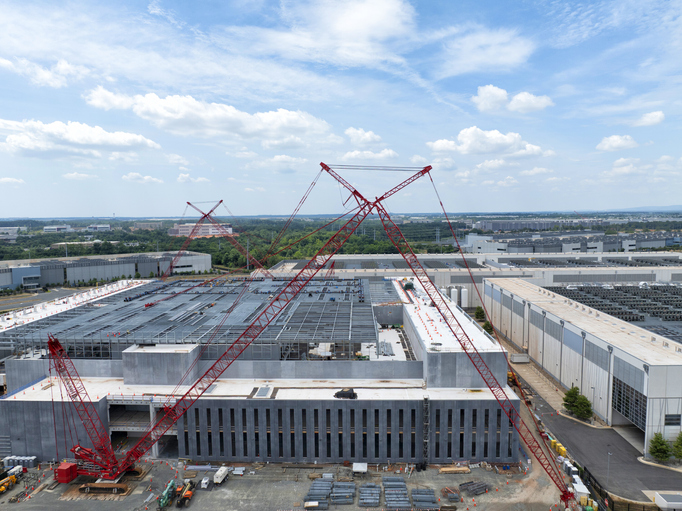

The race to build the infrastructure powering artificial intelligence is happening at an incredible pace. Across North America, massive data centers are rising from the ground almost overnight as companies invest billions into cloud computing, AI processing, and digital storage. While most attention is focused on the technology inside these facilities, another transformation is happening behind the scenes in the materials used to build them.
As public infrastructure spending increases and hyperscale data center construction accelerates, owners, regulators, and contractors are asking tougher questions about embodied carbon, sustainability reporting, and supply chain transparency.
That shift is changing expectations for producers.
Between Buy Clean legislation, ESG procurement standards, and sustainability goals set by some of the world’s largest technology companies, producers are increasingly expected to provide accurate, verifiable environmental data alongside the materials themselves.
For many companies, the challenge is not understanding why sustainability matters. The challenge is figuring out how to operationalize it without creating more manual work, more delays, or more overhead.
That is where automation starts to matter.
Command Cloud EPDs help producers simplify and scale EPD generation by using the operational data they already have. Instead of relying on spreadsheets, disconnected systems, or consultant-heavy workflows, the platform connects directly to sourcing, mix, and production records to generate compliant, traceable EPDs grounded in real plant data.
Timing could not be more important.
The rapid expansion of AI infrastructure has turned data center construction into one of the largest building booms in decades. Companies like Microsoft, Meta, Google, and Amazon are investing heavily in hyperscale campuses, many of which are being designed around aggressive sustainability targets. Increasingly, those projects require suppliers to provide low-carbon materials backed by verified EPDs.
Concrete sits at the center of that conversation.
Data centers consume enormous volumes of concrete, making embodied carbon a major focus during design and procurement. Owners want transparency into the environmental impact of the materials being used, not just broad sustainability claims. In many cases, EPDs are becoming just as important to the bid process as cost, availability, and production capacity.
The same pressure is coming from public infrastructure through Buy Clean legislation, which is reshaping how materials are evaluated on government-funded projects. These policies are designed to reduce embodied carbon by prioritizing products with lower environmental impact and requiring standardized reporting through EPDs.
For producers, the message is becoming increasingly clear. Sustainability data is no longer optional paperwork sitting on the sidelines of operations. It is becoming part of the competitive landscape.
The challenge is that traditional EPD creation has often been slow, fragmented, and difficult to scale. Gathering production records, supplier information, mix designs, and lifecycle assessment data manually can turn sustainability reporting into a time-consuming process that competes with day-to-day operations.
Command Cloud EPDs approach the problem differently by pulling directly from actual production and material records to streamline the process. Material Supply and Dispatch systems work together to capture supplier data alongside 12 months of production and mix-design records, which are critical inputs used to calculate Life Cycle Assessments and generate EPDs.
The result is a workflow that feels less like an administrative burden and more like an operational advantage.
Because the data is connected directly to plant operations, producers can generate EPDs faster, reduce manual entry, improve consistency across locations, and respond more quickly when sustainability documentation is needed for bids or compliance. As reporting requirements continue expanding across both public and private construction, that speed and reliability become increasingly valuable.
What makes this moment particularly interesting is that sustainability and profitability are no longer viewed as competing priorities. Producers are under pressure to lower carbon impacts while also moving faster, operating leaner, and staying competitive in a rapidly evolving market. Automation helps bridge that gap by reducing operational friction traditionally associated with sustainability reporting.
Companies that can provide trusted environmental data quickly and confidently are increasingly the ones best positioned to win projects, expand into new markets, and build stronger relationships with sustainability-focused customers.
As AI infrastructure, public works, and ESG-driven development continue reshaping construction, expectations around transparency will only continue to grow. Producers will not just be evaluated on what they deliver, but also on the environmental story behind it.
In that environment, automated, data-driven EPDs are starting to look a lot less like a future initiative and a lot more like essential infrastructure for the modern producer. To learn more, click here.